

Project portfolio management (PPM) brings a structured approach to evaluating, prioritizing, and managing multiple projects at once. In this guide, learn about the benefits, challenges, and future of PPM, with pro tips, a free starter kit, and a software comparison matrix.
Included in this article, you’ll find the following:
What Is Project Portfolio Management (PPM)?
Project portfolio management (PPM) is the practice of selecting, prioritizing, and managing a set of related projects to drive strategic objectives. Managers prioritize portfolios using defined criteria and assign resources accordingly.
Summary Overview
|
For example, a healthcare company might have 20 potential IT upgrades but only enough staff and budget to tackle six this year. To prioritize the upgrades project, leaders score each proposal using factors such as compliance urgency, patient impact, and return on investment (ROI), then select and schedule the highest-value projects within capacity.
PPM can be scaled for any department or volume of projects, ranging from a specific area such as IT portfolio management to overseeing the entire organization through enterprise PPM (EPPM).
Why Is Project Portfolio Management Important?
Project portfolio management enables companies or departments to strategically organize, prioritize, and execute on multiple initiatives simultaneously. PPM ensures all initiatives map to business objectives, get the necessary resources, and work in unison.
Project portfolio management also provides a standardized methodology, which enables projects to proceed with more clarity. PPM ultimately serves an organization’s strategic goals and bottom line.
Without PPM, worthwhile projects might fall prey to organizational siloes, insufficient resources, poor prioritization, or conflicts.

“As a project manager, I’ve found PPM especially effective in matrixed organizations, where cross-functional collaboration is critical,” says Lulu Richter, Senior Technical Project Manager at Smartsheet. “Siloed teams can be more effective in their specific functions but lack insight into other teams’ initiatives. Many times, I’ve seen projects entirely derailed because their goals and objectives conflicted with those of another team.”
Core Functions of Project Portfolio Management
Project portfolio management (PPM) relies on six core functions to coordinate strategy, resources, and execution. The functions ensure the organization pursues the right work, allocates capacity effectively, and tracks results to make good, data-driven decisions.
Each PPM function plays a distinct, ongoing role in maintaining portfolio health:
- Portfolio Visibility: Inventory existing work and projects before you begin. Maintaining an accurate, current view of all active and proposed initiatives gives leaders a framework to evaluate priorities and identify overlap or misalignment. Visibility is the foundation for confident portfolio decisions.
- Demand Management: This second function governs how new work is accepted into the portfolio. To manage project intake, preset criteria by which to assess each request’s value and feasibility. Ensure that only strategically aligned proposals move forward.
- Prioritization: In order to evaluate and prioritize projects, focus on initiatives that create the most value. Using predefined criteria — such as ROI, risk, and strategic fit — leaders can rank projects and readjust priorities as business conditions evolve.
- Resource and Capacity Management: This function balances people, budgets, and time across approved work. Capacity planning highlights oncoming bottlenecks early, prevents overload, and ensures that critical initiatives get the support they need.
- Project Execution Oversight: Track performance throughout the portfolio to confirm that projects stay aligned with strategy. This way, leaders can intervene when issues arise, which allows teams to keep delivery on target.
- Reporting and Performance Monitoring: Measure progress against key metrics, such as budget, schedule, and benefits realized. Regular reporting gives executives visibility into performance and supports continuous improvement.
While these six functions are the foundation of effective portfolio management, mature organizations often add supporting disciplines, such as governance and strategic alignment, financial management, and portfolio-level risk oversight. These functions help to strengthen strategic decision-making.
For a deeper look at how these functions flow together within the full lifecycle, see our guide to the project portfolio management process.
Benefits of Project Portfolio Management
The key benefit of project portfolio management is strategic alignment. With PPM, businesses focus on a set of projects that drive business goals — this increases impact, efficiency, and value realization. In the long term, PPM makes a company more profitable and competitive.
The best-performing organizations stand out sharply. In PMI’s Pulse of the Profession 2024 report, those in the top quartile achieved on-target results for 96% of their projects, versus a global average of 74%. They also experienced far less scope creep (23% versus 49%) and lower budget loss (20% versus 35%).

“The benefits of developing and maturing a PPM process represent a continuum,” says Alan Zucker, a project management and PPM consultant and coach with more than 25 years of experience.
“At one extreme is chaos: Money is spent on projects with no control, alignment, or accountability,” he says. “At the other end of the spectrum, there would be an efficient and transparent process. The enterprise can effectively manage its investments to ensure alignment and maximize its investments. [At this end of the spectrum], there is transparency into the status of projects and programs so that appropriate corrective actions would be taken if there are problems.”
Additional benefits of PPM are described below:
- Strategic Alignment: PPM ties every initiative to business strategy and long-term goals. Instead of pursuing disconnected projects, organizations use PPM to maintain a clear line of sight between strategic objectives and individual project execution.
Zucker suggests starting with why to keep the focus on strategic alignment. “When consulting with clients, I ask, ‘Why are you executing this project? What are you hoping to achieve? How does it align with your organization’s strategy and goals?’”
- Project and Resource Prioritization: PPM creates a framework to rank projects against consistent criteria such as strategic fit, risk, and resource demand. By applying a standardized scoring method, teams make transparent, evidence-based decisions to prioritize all projects and resources.
“In a good PPM solution, your project is always evaluated within the context of the larger portfolio goals,” Richter of Smartsheet says. “As a result, it becomes easier to prioritize the highest-value work, allocate resources effectively, and identify potential conflicts with other projects.”
- Value Realization: PPM measures whether projects deliver their intended business value — financial, strategic, and operational. Track traditional ROI alongside other benefits such as risk reduction, productivity, and better customer outcomes. By monitoring benefits from initiation through post-implementation, organizations can see which investments pay off and learn from that.
- On-Time Delivery: PPM helps teams finish projects faster by aligning priorities, resolving conflicts early, and providing resources on time. Timely completion increases confidence in the team and accelerates the realization of business benefits.
- Project Efficiency: Standardized processes promote higher efficiency and productivity. PPM prevents projects from being siloed and provides prioritized resources on time. Without project portfolio management, projects tend to operate in isolation and often clash with each other.
- Budget Alignment: PPM aligns project timing with department budgets while incorporating flexibility for market changes and helps to flag pending cost overruns.
- Resource Optimization: PPM provides organizations with a centralized resource view that facilitates timely allocation to projects and reduces delays. Project teams will likely still feel competition for resources (including funding, people, supplies, equipment, and technology), but PPM provides a set method for assessing which projects receive which resources.
- Risk Management: PPM establishes standard criteria to assess risk. PPM takes a holistic, analytic view of risk and helps manage it effectively.
- Transparency: PPM encourages reporting and dashboards, enabling everyone to view progress and problems. These features are a centerpiece of PPM software.
- Enhanced Forecasting: With unified data on resources, budgets, and schedules, PPM makes forecasting more accurate. Leaders can anticipate oncoming issues and adjust before they affect delivery.
- Accountability: PPM encourages a performance-based work culture by setting success criteria and measuring project outcomes.
For the best results, Zucker recommends giving decision-making power to those closest to the work. “When we push decision-making up, then people that are close to the work aren't accountable. It's like, ‘Why should I worry? Because my director or my VP made that decision.’ But if you push decision-making down, people own it, and they feel responsible. They make the right decisions.”
- Employee Retention: PPM lessens burnout by improving workload balance. Additionally, when people see how their efforts support the business objectives, they’re more engaged and likelier to stay.
- Longer-Term Planning: PPM aligns objectives and results, which sets the stage for longer-term planning. With clarity on what they’ve achieved in a year, companies can now look further ahead.
“In any organization where there are a large number of projects operating simultaneously, PPM helps teams align on strategic goals, reduce inefficiencies, and build effective long-term plans,” Richter says.
Here’s a detailed look at common best practices for the project portfolio management process.
Challenges of Project Portfolio Management
The most common challenges with project portfolio management include complexity with implementation, change fatigue, bureaucracy, communication and collaboration breakdowns, and outdated tools and technology. But organizations that build structured supports — such as training and mentoring — overcome these challenges.
According to PMI’s Pulse of the Profession 2024, companies that establish at least three organizational “enablers,” such as mentoring, communities of practice, and skills development, report project success rates eight percentage points higher than those without enablers.
Here’s a closer look at frequent PPM obstacles and how to handle them:
- Initial Investment: Launching a portfolio management framework requires upfront investment in people, training, and tools. You’ll likely need to hire people with PPM expertise, purchase or configure a platform, and focus time and energy on successful adoption.
Costs can be substantial, but so are long-term gains in efficiency and strategic control. A cost-benefit analysis can help you demonstrate how PPM’s efficiencies and alignment justify the investment. (Also, see the project portfolio management starter kit below, which includes a slide deck to make the case for PPM at your company.)
- Implementation Challenges: PPM implementation can be time-consuming due to complexity, and it might even initially lower productivity until it takes root.
“Project portfolio management is a simple concept, but can be incredibly difficult to implement,” says Richter of Smartsheet. “A PPM solution needs to work at every level of the organization and be adapted to dramatically different audience types. It can be time-consuming to create and maintain the system required to support true PPM. Even the best portfolio management framework can fall apart if there isn’t total buy-in from the teams expected to work within it.”
Zucker emphasizes overall Lean thinking as a way to overcome PPM challenges: “Lean portfolio management is a reaction to a lot of the problems that we'd seen in the traditional view of portfolio management — for example, creating flow, pushing decision-making down, and eliminating waste.”
For details on how PPM works, see these guides on implementing PPM effectively and PPM processes, phases, and workflows.
- Change Management and Change Fatigue: Managing change is one of the toughest aspects of portfolio management. As organizations scale and projects multiply, priorities shift more frequently. Without open communication and realistic pacing, employees might feel change fatigue, where the constant pivoting undermines productivity and morale.
The 2025 Smartsheet PPM Priorities report finds that 92% of PPM professionals say adapting to change remains a significant struggle, and 71% say constant workplace shifts make it difficult to stay productive. Frequent reprioritization without clear guidance, the report notes, leads to disengagement.
The report also notes that organizations that establish a clear, repeatable framework for managing change adapt significantly faster than those that respond reactively.
- Limited Visibility With Data Silos: Portfolio success depends on transparency, but many organizations can’t see across departments, projects, and systems. That means you can’t uncover risks or make informed tradeoffs.
According to the Smartsheet study, 66% of PPM professionals lack visibility into the information they need when change occurs, and 37% cite poor access to project data as a top barrier to adaptability. Visibility gaps like these often trace back to disconnected systems or manual reporting processes — issues modern PPM software aims to solve.
“Organizations face many challenges in making strategic decisions, with the top three all relating to their ability to access the right data at the right time,” the report states. “For most, data/information need to be collected from multiple teams (38%), reside in different systems (35%), and lack consistency (35%).”
Smartsheet Marketplace add-ons, such as Data Shuttle and Resource Management, help bridge system gaps by syncing data across platforms and enabling workload visibility.
- Communication and Collaboration Breakdowns: PPM thrives on alignment across functions, but communication barriers can stall even well-planned portfolios. Teams may have differing interpretations of priorities or incomplete information about interdependencies, which creates inefficiencies and redoing work.
In Smartsheet’s 2025 survey, 45% of professionals identified ineffective communication and collaboration as their biggest obstacle to adapting to change. This finding reinforces what many experts observe: The success of PPM relies on both technology and culture, particularly transparency and shared understanding.
The report recommends that leaders communicate not just what is changing, but why. Link each change to business impact and employee benefit to maintain engagement during transitions.
- Inflexible or Outdated Tools: Legacy tools or rigid processes can make PPM cumbersome. When teams have to enter data manually or systems don’t talk to one another, teams lose the speed and adaptability that PPM is designed to deliver.
The Smartsheet report found that 43% of respondents struggle with inflexible technology or processes, while 39% point to manual workflows for intake, execution, and reporting as major barriers.
The Smartsheet report also notes that technology plays a major role in overcoming many PPM challenges. Nearly all professionals (99%) said better tools — particularly those supporting collaboration, analytics, and automation — would help their organizations adapt to change more effectively.
- Ongoing Administrative Costs: PPM has ongoing administrative costs that may or may not be higher than a company’s previous project efforts. These costs could include team members with PPM expertise, including a PPM VP or director. There’s also the cost of the technology, including maintenance. The idea is to offset any increased costs with increased ROI.
- Bureaucracy: Too much oversight can slow decision-making and dampen innovation. While structure and accountability are essential, excessive review cycles and approvals can frustrate teams and undermine agility.

“We were guilty of this by creating the project intake forms and approval processes so complex that the production teams had difficulty coping with them,” says Leon Huang, CEO at RapidDirect, an on-demand manufacturer that specializes in custom parts.
“We corrected this by taking a Lean approach — always asking ourselves if the step adds value as it relates to the manufacturing process. We streamlined our PPM processes by focusing on what was necessary and eliminating unneeded bureaucracy.”
- Funding Overload: With PPM, annual funding cycles might lead to excessive project requests and resource commitments. This can result in teams being overwhelmed and unable to complete projects effectively.
“Traditionally, organizations have annual funding cycles,” Zucker says. “A lot of time and effort is expended developing project requests and budget justifications. Teams request two or three times more money than they could reasonably spend under the expectation that the request would be halved. Then, at the beginning of the year when the funds are released, teams start executing more projects than they can effectively manage. Everyone is very busy, but projects are not getting completed.
“To improve the process,” he continues, “we can take lessons from Lean. Rather than having effort-intensive annual funding processes, simplify everything. Move to a rolling funding model. Push tactical funding decisions down to the lowest responsible level in the organization. Create pull and do not start a new project until the teams have the capacity to deliver it.”
- Required Skill Sets: An organization may need to hire people with PPM expertise to implement and run this new approach, which can be expensive and time-consuming. However, just as the increased administrative costs can be offset with a high ROI, the benefits of PPM training can be extensive. For example, team members can use the training as an opportunity for professional growth.
- Low Project Manager Influence: Depending on the company’s structure, project managers might lose influence and some decision-making authority in a PPM system. This is also true of departments as a whole.
However, this doesn’t happen in all companies, and it can pay to listen to your project managers and give them authority.
Zucker gives this example from personal experience: “At one point in my career, I managed an organization with 175 project managers,” he says. “I recognized that there was no way I could keep track of the 150 or so projects that were in process at any given time, so I told my managers that they were responsible for each of their portfolios. I only asked that they let me know before a project went sideways so that we could collaborate on the solution. I was there to support them. And it worked great.”
- Executive Micromanagement: PPM tools and dashboard metrics can lead to centralized decision-making and micromanagement. Ground rules are necessary to delineate who has decision-making authority.
“The PPM tools, metrics, and reports only tell a small part of the story,” Zucker says. “To understand how a project is performing, you need to talk to the team to understand what is happening on the ground.”
He gives this example of micromanagement: “I worked for a vice president who was a micromanager. He would read the 300-page report that came out of the PPM system each week. That was a huge waste of his time. He should have created an environment where people felt comfortable raising issues and concerns directly to him.”
- Overcomplication: PPM may be too complex for smaller businesses with fewer projects. However, PPM practices might help with strategic alignment, even in small businesses.
“Like any project, potential benefits need to be evaluated against the cost; project portfolio management will not work in every scenario,” Richter says. “If you’re struggling to align functional teams with larger strategic goals, PPM can be a powerful tool to transform the way you work.”
To overcome any of these PPM challenges, start with structure and transparency. For a deeper look at solutions, see our guide to successful project and portfolio management. You’ll learn to take stock of the work already in progress and establish processes for managing your resources and incoming requests.
The Future of Project Portfolio Management
The future of project portfolio management will be shaped by technological acceleration and a growing demand for strategic fluency. The next generation of PPM will combine intelligent automation with deeper business insight — where data moves faster and decisions get smarter.
Here’s what the coming years could hold for project portfolio management:
- AI and Automation: Artificial intelligence (AI) and automation are already shaping modern portfolio management. While many PPM tools today include automation (streamlining updates, routing approvals, and syncing data), early AI capabilities are beginning to add deeper context.
Emerging features now use machine learning in limited ways to flag risks, analyze performance trends, or summarize portfolio updates automatically. These capabilities are still developing but expanding quickly — and as they mature, AI will move beyond reporting to help anticipate problems and recommend adjustments in real time. This will make portfolio oversight faster, more accurate, and less manual.
In parallel, explainable AI and autonomous agents will start to surface — systems that can act on predefined rules while providing full transparency into how and why they make recommendations. The goal will be to enhance, not replace, human decision-making.
According to Smartsheet’s 2025 research, 99% of professionals say their organizations would benefit from better enabling technology, and half specifically cite AI and workflow automation as critical for adapting to change.
- Better Forecasting and Decision Support: As automation and AI make data timelier and more reliable, forecasting will evolve from backward-looking reports to forward-looking guidance. Predictive analytics will model how changes in timing, budget, or staffing could affect outcomes before decisions are made.
Next-generation forecasting will also broaden its scope, factoring in resilience, sustainability, and other long-term performance metrics alongside cost and schedule projections. The next wave of PPM tools will combine real-time data and predictive modeling to support faster, more confident portfolio choices, to turn insight into proactive action.
- Business Acumen Becomes the Differentiator: As automation takes over more routine work, organizations are beginning to place greater emphasis on strategic and financial literacy.
The PMI Pulse of the Profession 2025 found that only 18% of project professionals demonstrate high business acumen, and that select group outperforms their peers on schedule and budget adherence. PMI defined business acumen by combining self-assessed proficiency in eight core business skills — such as stakeholder management and financial understanding — with how frequently respondents applied those skills to mitigate real project challenges.
In the coming years, portfolio success is likely to depend on leaders who can interpret data, weigh trade-offs, and connect investment decisions directly to enterprise strategy. As organizations promote these skills, the PMO’s purpose is expected to evolve as well, shifting from oversight to strategic partnership.
- Increasing Hybrid Models for Manufacturing: Many project portfolios now run under hybrid frameworks, combining the deadline rigor of Waterfall for production initiatives with Agile sprints for innovation and research and development (R&D).
“The rigid, Waterfall-only approach is becoming less effective as the pace of change accelerates,” Huang says. “Instead, we envision frameworks that allow for a structured stage-gate process for high-volume production lines, while enabling Agile management for R&D and prototyping projects within the same portfolio.”
- 3D Simulation Tools in Resource Planning: Advanced 3D simulation tools are becoming useful in PPM, especially in capital-intensive industries. You can visually model resource allocation, spatial constraints, and project interactions, as well as spotlight potential issues.
These simulation platforms are also evolving into digital twins: virtual models that represent entire portfolios. Companies can test resource, financial, and scheduling decisions in a virtual environment before execution.
- Continuous, Adaptive Reprioritization: More PMOs are expected to use rolling planning cycles that replace static annual plans. That facilitates faster, more flexible responses to changing business conditions and new priorities.
Smartsheet’s 2025 findings illustrate this need: 87% of professionals saying their teams would be more effective by proactively preparing for change.
- Integrated, Data-Driven Ecosystems: PPM platform integrations with enterprise resource planning (ERP), customer relationship management (CRM), HR, and business intelligence (BI) systems are becoming more common.
According to a PPM software report from Grandview Research, the growing demand for connected systems is helping drive the global PPM software market, projected to rise from USD $5.7 billion in 2024 to $12.3 billion by 2030.
- Federated Governance With Guardrails: Governance structures are becoming decentralized. Teams are gaining more authority to act locally, while portfolio-level controls and policy automations ensure compliance.
Smartsheet Control Center is one example of this balance. Control Center standardizes and automates project creation and provides greater visibility into portfolio reporting, so teams can move quickly while PMOs maintain oversight.
In the future, federated learning models might enable AI to learn from distributed data sources — safeguarding privacy while strengthening portfolio insights throughout departments.
- Value Realization as the Core Metric: More organizations are beginning to track the business outcomes of their portfolios, not just delivery metrics. Continuous benefit measurement and post-implementation feedback are expected to become standard indicators of success.
Smartsheet’s 2025 report illustrates how far many teams still have to go: 58% of PPM professionals say their current tools make it hard to demonstrate business value, and 53% cite data and visualization as essential to improving adaptability.
Project Portfolio Management Starter Kit
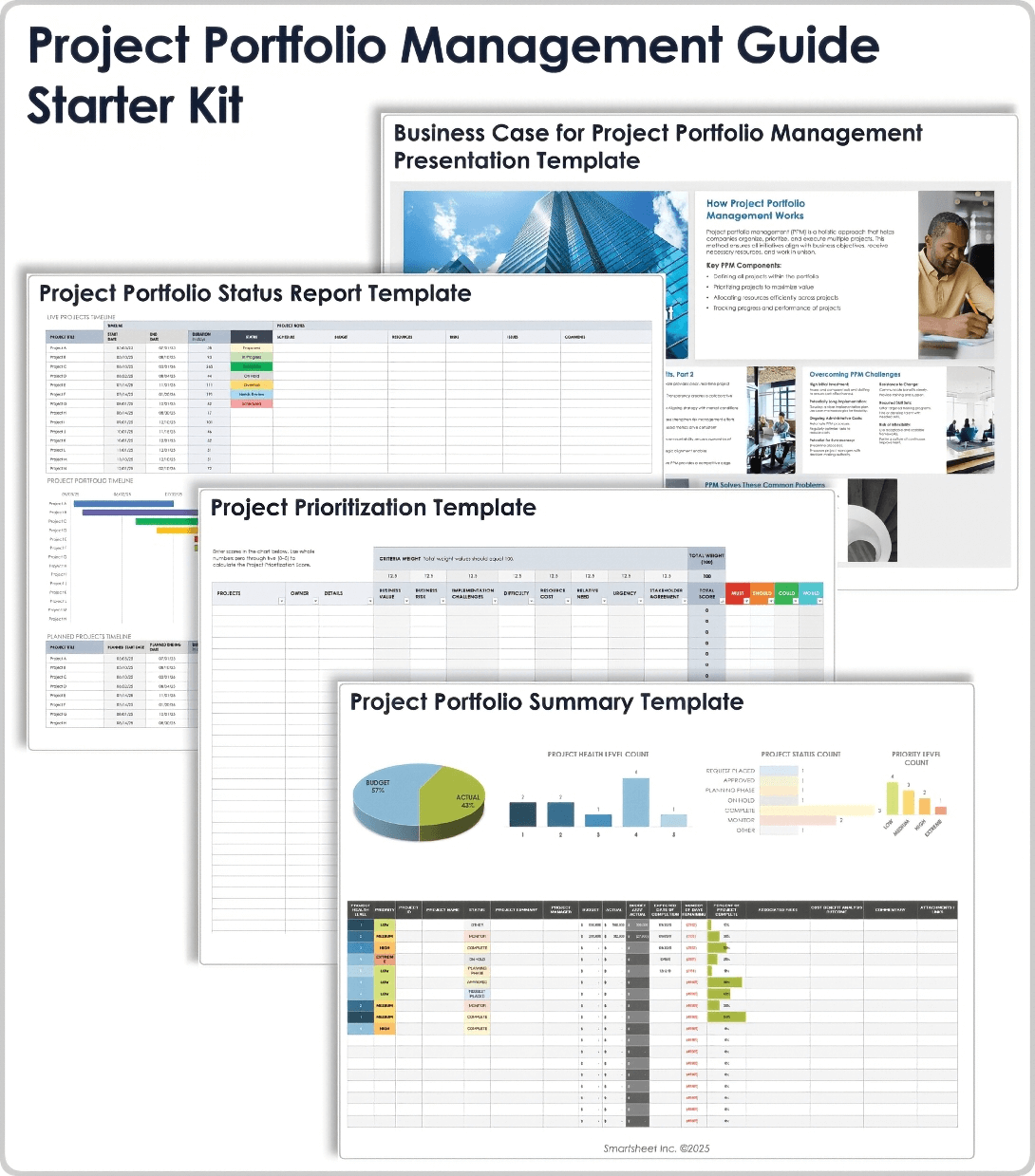
Download the Project Portfolio Management Starter Kit
Use this free starter kit to introduce or improve project portfolio management for your team or organization.
In this kit, you’ll find:
- A project prioritization template in Excel to rank your projects by priority, using the criteria you set.
- A project portfolio status report template in Excel to display a 12-month timeline of project statuses, with details and summaries for each.
- A project portfolio summary template in Excel to see both spreadsheet and dashboard views.
- A slide deck on the business case for PPM in PowerPoint to persuade others at your organization.
Choosing the Right PPM Software Tool
Take a methodical approach to selecting PPM software. The right tool should help your organization connect strategy to execution, make data-driven decisions, and shift quickly as priorities change.
Use the criteria below to guide your demos and evaluations:
Evaluate How It Connects Work to Strategy: How does the software visualize how projects drive company goals or OKRs? A strong PPM system lets teams and executives see at a glance whether current initiatives advance strategic objectives — and how quickly.
Examine How It Supports Prioritization and Change: Look for built-in scoring models, workflow automation, and what-if scenario planning. During demos, test whether you can quickly see how funding cuts, resource shifts, or timeline changes would affect the portfolio.
Assess Visibility Into Resources, Capacity, and Money: The right platform makes people, budgets, and time transparent across all portfolios. Check if each solution forecasts demand, flags conflicts early, auto-notifies owners when you cross thresholds, and helps you balance workloads before they create delays.
See How It Turns Data Into Insights: Dashboards should do more than display charts — they should also help you make faster, better decisions. Explore whether the tool has predictive analytics or AI summaries that automatically spotlight trends, risks, or anomalies.
Review How It Integrates With Your Other Systems: Integration determines whether data is accurate and current. Ask which systems the tool connects to — finance, HR, CRM, and PPM work-management platforms such as Smartsheet — and whether the sync is two-way or manual.
Weigh Usability and Governance in Tandem: Even the best software fails if teams don’t use it. Assess the tool’s ease of configuration, onboarding support, and role-based views alongside security features such as SSO, data encryption, and audit trails. The right tool will balance flexibility versus control.
Gauge Scalability and Long-Term Fit: Can the software scale from a single department to enterprise-wide use? Ask how it supports multiple delivery methods — Agile, Waterfall, or hybrid — and whether you can reconfigure it easily as your PPM practice matures.
Examine the Vendor Partnership: Implementation and adoption often determine success more than features. Ask about onboarding, customer community, and product roadmap. Find a vendor that offers ongoing support and innovation, not just a one-time license.
Once you’ve explored these questions, use the feature comparison matrix below to translate what you learned into a clear, side-by-side evaluation.
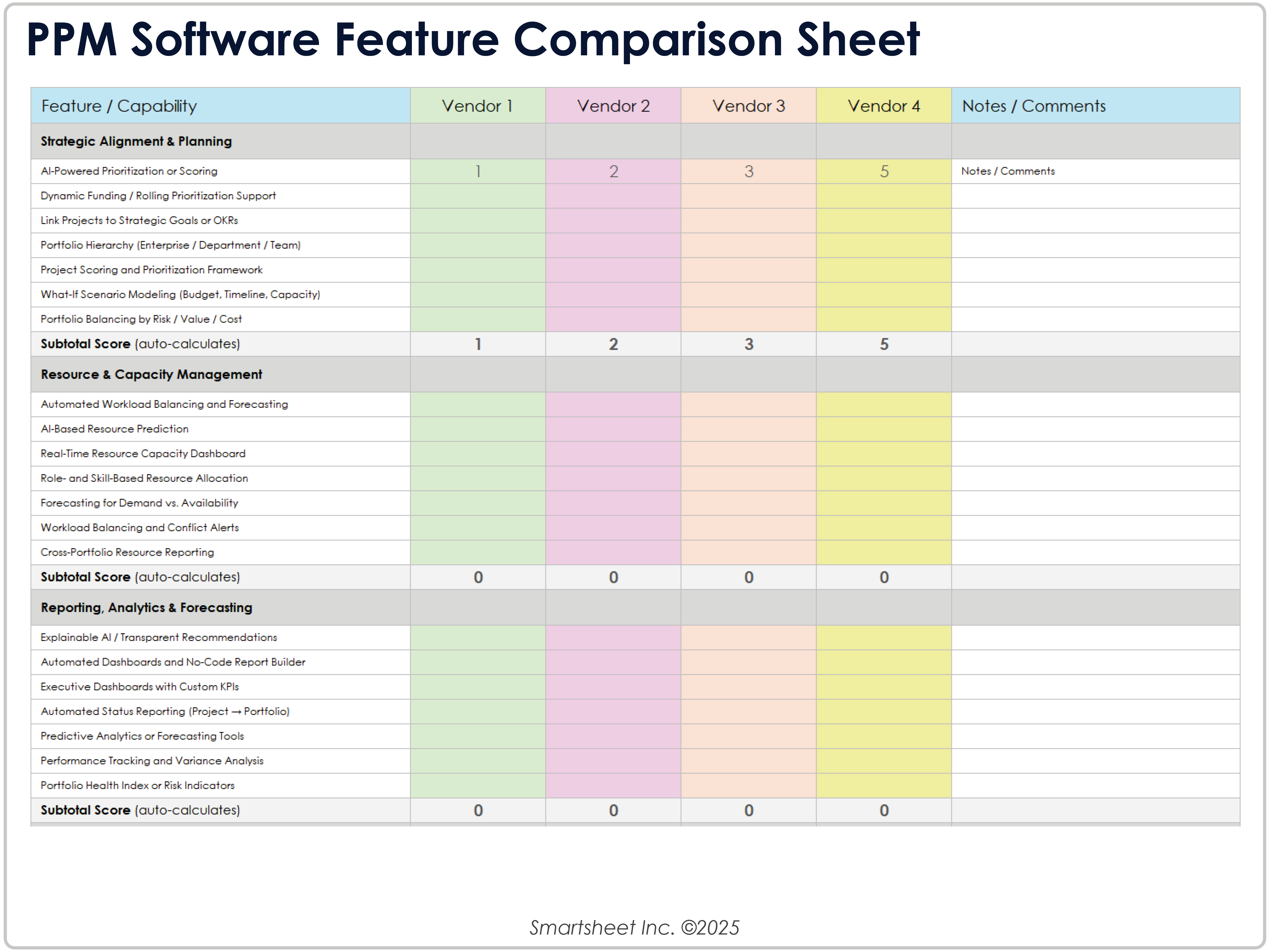
PPM Software Feature Comparison Sheet
If you’re in the market for a PPM platform,
download this free PPM software feature comparison sheet
. It enables you to score competing vendors on a 1-5 scale for each feature. The sheet automatically gives you subtotals by categories and a total for each vendor, providing an objective selection process.
Expertly Manage Multiple Projects With Smartsheet
From simple task management and project planning to complex resource and portfolio management, Smartsheet helps you improve collaboration and increase work velocity -- empowering you to get more done.
The Smartsheet platform makes it easy to plan, capture, manage, and report on work from anywhere, helping your team be more effective and get more done. Report on key metrics and get real-time visibility into work as it happens with roll-up reports, dashboards, and automated workflows built to keep your team connected and informed.
When teams have clarity into the work getting done, there’s no telling how much more they can accomplish in the same amount of time. Try Smartsheet for free, today.
Project Portfolio Management FAQs
The main goal of PPM is to strategically align projects with business objectives. Projects must compete against a set of prioritization criteria, and the ones with highest value advance.
Portfolio management is the practice of strategically prioritizing a group of initiatives, either across the organization or within a department. Instead of managing projects as individual units, portfolio managers handle them collectively.
A project portfolio is a set of projects in an organization or department. By grouping projects, managers take a coordinated, strategic view of prioritization and resource allocation.
