What Is Enterprise Project Portfolio Management (EPPM)?
Enterprise project portfolio management (EPPM) is the coordinated management of project portfolios across an organization. It helps leaders prioritize projects, track progress, and manage resources to align with company goals. Unlike portfolio management within a single department, EPPM provides a bird’s-eye view of a company’s priorities, resources, and performance.
Here are some benefits that EPPM provides:
- Consistent Standards: EPPM can create a common process for intake, including reviewing, approving, and prioritizing work across portfolios.
- Comparable Data: It allows shared criteria, metrics, and reporting to help leaders compare portfolios and make more informed decisions.
- Enterprise-Wide Trade-Offs: EPPM helps leaders to adjust resources, budget, and capacity when priorities shift across divisions.
How Is Enterprise PPM Different From Traditional PPM?
Enterprise PPM differs from traditional PPM by extending across the whole organization, using a consistent strategy and framework to give leaders a unified view of priorities, performance, and resources.

PPM remains the foundation for sound portfolio management at any level, and EPPM extends this. “The real value of enterprise project portfolio management lies in its ability to connect every project to the organization’s bigger goals,” says Yad Senapathy, Founder and CEO of the Project Management Training Institute. “It brings a single view of all work, resources, and costs across departments, which traditional PPM rarely achieves. This unified system helps leaders see where money and time are being spent and how projects contribute to strategic outcomes.”
| Dimension | Project Portfolio Management (PPM) | Enterprise Project Portfolio Management (EPPM) |
|---|---|---|
| Scope | Applies portfolio management within a defined area or line of business | Connects multiple portfolios across the organization under common standards and oversight |
| Focus | Aligns projects to strategic goals within a single portfolio | Aligns all portfolios to enterprise objectives and balances competing investments |
| Governance | Managed through a PMO or portfolio steering committee | Directed by an enterprise PMO (EPMO) that enforces standards and oversees funding |
| Resource Management | Optimizes resources within a portfolio or department | Manages enterprise-wide capacity to lessen conflicts and balance shared services |
| Visibility | Offers dashboards for portfolio performance | Provides a single view of investments, capacity, and risk across all portfolios |
What Are the Benefits of EPPM?
Enterprise project portfolio management (EPPM) has many benefits, including a unified strategy, enterprise-wide visibility, consistent governance, cross-portfolio resource balance, and faster decision-making. These benefits help organizations better align projects, resources, and investments with company goals.
Here are some of the benefits of EPPM:
- Unified Strategy Execution: Every portfolio and investment is aligned with enterprise objectives.
Enterprise Visibility: The right platform provides a single, organization-wide view of spending, capacity, progress, and risk. - Enterprise Financial Management: Leaders can make better investment and funding decisions with a more consolidated view of costs, expenses, budgets, and forecasts.
- Investment Analysis: EPPM allows leaders to compare initiatives using consistent criteria.
- Cross-Portfolio Resource Balance: Planning demand and capacity at the enterprise level ensures effective coordination and resource management.
- Governance and Compliance: Common intake and approvals help organizations maintain better governance and compliance.
- Faster Decision Cycles: When priorities change, consistent data and dashboards help EPPM leaders make decisions quickly.
- Management of Risk and Dependencies: Interdependencies surface early with EPPM, reducing enterprise-level exposure and schedule surprises.
- Benefits Realization Tracking: EPPM allows outcomes to be measured beyond project delivery to track long-term value.
The stakes are significant. According to the Project Management Institute’s 2026 Pulse of the Profession report, nearly one-third (31 percent) of complex projects fail to achieve the full scope of their intended benefits. Strong EPPM practices can help organizations maintain strategic alignment and keep intended business outcomes in focus.
Common EPPM Challenges and Tips to Overcome Them
Common enterprise project portfolio management (EPPM) challenges include gaining consensus on a standardized approach, managing change across teams, keeping data consistent, and maintaining clear centralized authority. Organizations can overcome these challenges by involving stakeholders early, establishing clear governance, standardizing processes, and supporting teams through change management.
Here’s a look at some common obstacles and how to handle them:
Getting Consensus on a Standardized Approach
Implementing EPPM requires well-defined objectives and input from all stakeholders to come to a consensus on planning, tracking, and reporting work across the organization.

“The biggest challenge is that a successful EPPM approach requires consensus throughout the organization on how work will be managed — from individual task management up to portfolio-level reporting,” says Lulu Richter, formerly a senior technical project manager at Smartsheet. “In enterprise organizations, large workforces and often complex reporting structures make finding a single, consistent management approach for all use cases exceptionally challenging.”
Getting consensus typically requires well-defined objectives, input from all departments, and a visible commitment to a unified EPPM approach.
Ensuring the EPMO Maintains Clear Authority
The enterprise project management office needs support from senior leaders to make decisions across departments and prevent silos.

“The hardest part of implementing or supporting EPPM is not the software or the processes; it is consistently enforcing portfolio-level governance,” says Mark Friend, Director at Classroom365 and former Global VPN Project Manager at the British Council.
“Moving from departmental PPM, every unit, department, or silo believes its own projects are the most important concern,” he says. “The challenge we had here was easily overcome by giving the EPMO direct, clear authority from the very top of executive leadership.”
Managing Organizational Change
Implementing EPPM requires departments to adopt shared processes and standards for executing projects, reporting, and making decisions. It can involve new tools or reduced departmental control that teams might resist. Organizations need ongoing training and adoption efforts to manage change.
According to the 2025 Project and Portfolio Management Priorities Report by Smartsheet, 92 percent of professionals said adapting to organizational change is difficult, and 61 percent of employees at large enterprises agreed that their company did a poor job of adapting to change. To overcome that, most complex organizations need strong EPPM with a change management plan.
“The hardest part of implementing EPPM is overcoming resistance to change,” Senapathy says. “Many teams are protective of their own data and hesitant to lose control.” However, he says, “building understanding starts with transparency. When people see how shared visibility benefits everyone, trust starts to grow. Showing leaders how fragmented systems waste effort often opens their eyes to the potential of EPPM. Once that happens, adoption becomes easier because they support the shift.”
Inconsistent Data Across Portfolios
Different departments may track projects in different ways. Some teams or portfolios may organize costs by department, while others organize them by project phase. This can make it difficult to combine information, compare work, and achieve maximum visibility into resource utilization and progress across the organization.
Two-thirds of the PPM professionals surveyed in the Project and Portfolio Management Priorities Report said they lack the data visibility required to pivot when plans change. Disconnected tools and systems create siloed reports and undermine the single source of truth essential for EPPM. Standardized data can help ensure accurate enterprise reporting and efficient resource management. Organizations can support this by investing early in integration architecture and automation.
Resistance to Centralized Governance
Moving portfolio decisions from individual departments to a central project management office can be difficult. Department leaders may worry that new processes will limit their control or slow their work. These leaders should be involved in implementing EPPM early in the process and be aligned with the need for EPPM. Letting teams help shape the new process can make the transition smoother and ensure better use of resources.
Excess Bureaucracy
EPPM can add new approval steps, requirements, and decisions. If the process is too complex, teams may view it as unnecessary red tape. For example, a low-risk software update should not require the same review and approval processes as a large business transformation project. Organizations should match oversight to each initiative’s size and risk.

Alan Zucker, a PPM consultant and coach with more than 25 years of experience, recalls an example of a company he worked with that had an enterprise portfolio management organization. The PPM team had 50–75 people, including a senior vice president, some vice presidents, and several directors. “They implemented and customized an enterprise tool. When a member of the PPM team attended an industry conference, they watched a vendor demo and realized they balled up the tool’s implementation,” Zucker says. “The intention was to create oversight and standardization … But things just became bureaucratic.”
What Is An Enterprise Project Management Office?
An enterprise project management office (EPMO) works across an organization to align projects and portfolios with business strategy, coordinate resources and reporting, and establish standardized governance.
Unlike a project management office (PMO), which supports project delivery within a department or business unit, an enterprise project management office (EPMO) works across the organization to align portfolios and projects with business strategy. An EPMO can also coordinate reporting, assign resources across an organization, and establish standardized governance. Enterprise project management (EPM) and portfolio management provide the processes for selecting and managing work across the organization, while the EPMO governs and implements these processes.
These are some of the top priorities of an enterprise project management office:
- Strategic Alignment: The EPMO helps turn corporate goals into specific priorities that influence project selection and success measurement.
- Governance and Standards: There should be a standard process for initiating, prioritizing, and reporting portfolios across the organization.
- Resource and Capacity Oversight: This involves managing cross-portfolio capacity planning and coordinating shared resources.
- Investment Planning: The EPMO oversees how the organization disburses, rebalances, and tracks funds across portfolios.
- Performance Reporting: Leaders should have one clear view of progress, risk, and value for all projects.
- Change Enablement: The EPMO drives adoption of EPPM tools and processes for all departments and maintains engagement with communication and training.
When established effectively, the EPMO connects enterprise strategy and delivery. It gives executives visibility into where the organization invests money and effort and how their decisions affect organizational goals, resources, budgets, and outcomes.
How to Know if Your Organization Is EPPM-Ready
Before starting EPPM, organizations need a strong foundation. They should be able to align on their goals and strategy, have reliable data, and coordinate effectively across departments. These conditions help build trust among teams and employees during an EPPM rollout.
Ideally, EPPM-ready organizations already have the following:
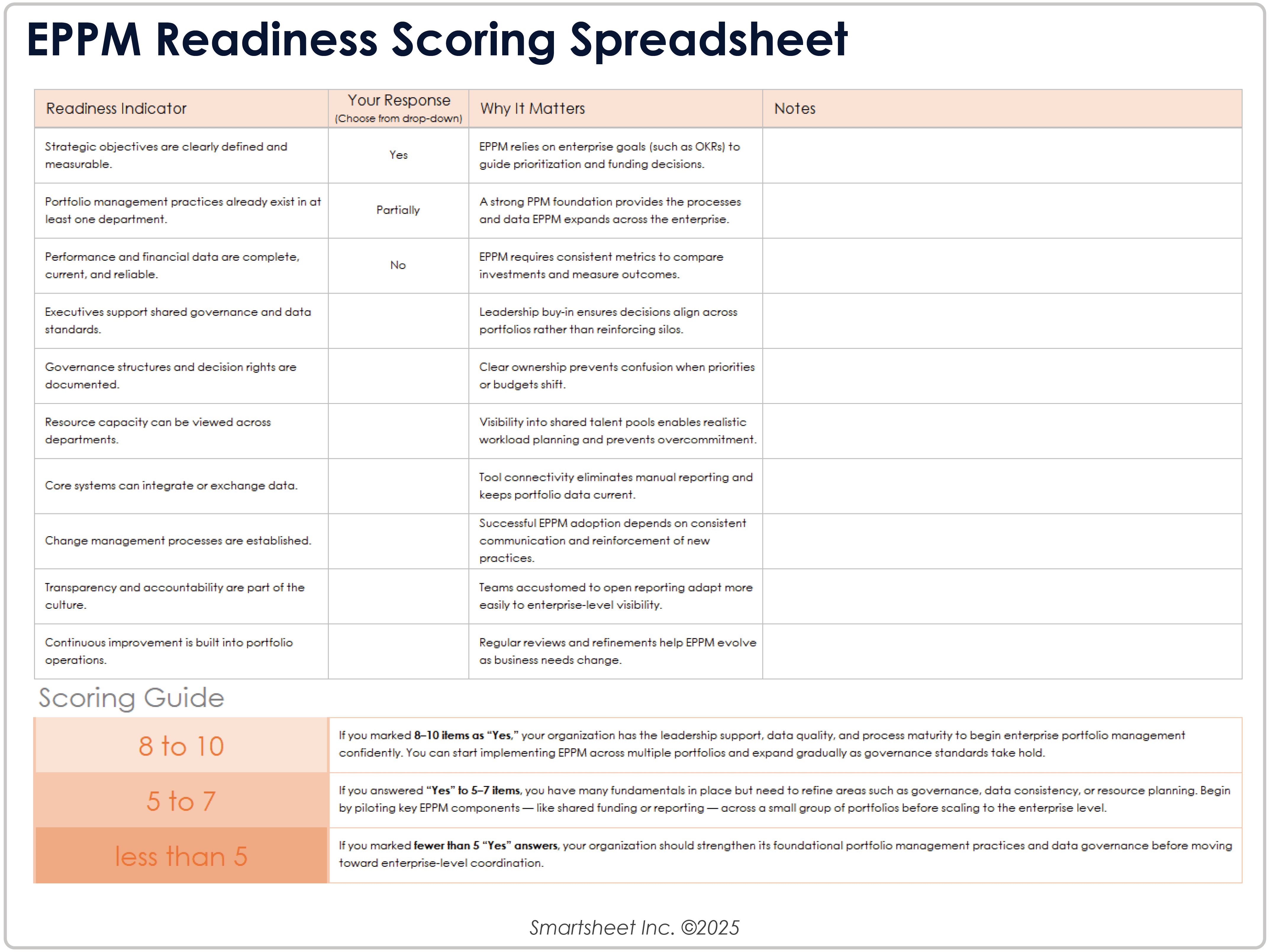
- Active Strategic Objectives: OKRs are defined and actively used to guide portfolio selection.
- Consistent Portfolio Practices: Departments already apply some form of PPM using shared criteria, processes, or tools to manage their own work.
- Reliable Performance Data: Project and portfolio data are complete, current, and accurate enough to support cross-portfolio comparisons.
- Executive Sponsorship: Senior leadership understands EPPM’s purpose and is committed to enforcing shared governance and data standards.
- Defined Governance Structures: The organization’s decision rights, approval gates, and review cadences are well-documented and accepted by all teams.
- Technology Infrastructure: Existing tools can integrate or exchange data, supporting a single source of truth.
- Change-Management Capability: The organization can communicate, train, and enforce new processes effectively.
- Culture of Transparency: Leaders and teams are accustomed to reporting results openly and acting on data-driven insights.
However, not all of these indicators need to be fully established before EPPM rollout. For example, standardizing portfolios and ensuring clear executive governance can be effective first steps to building PPM maturity before scaling to full enterprise portfolio management.
EPPM Readiness Scoring Spreadsheet
Download this free EPPM readiness scoring sheet in Excel to evaluate your organization’s current state. This checklist will help you decide whether to proceed now with EPPM or methodically mature your PPM practices first. You can fill it out individually, in a group meeting, or as a collaborative exercise among departments. Each “yes” response counts toward your total score:
- 8–10 Yes: You’re ready to coordinate portfolios under a unified enterprise model.
- 5–7 Yes: You’re close — start by piloting shared governance and reporting across a few portfolios.
- Fewer than 5 Yes: Strengthen portfolio management fundamentals before scaling enterprise-wide.
The checklist will help you decide whether to proceed now with EPPM or methodically mature your PPM practices first.
Download the EPPM Readiness Scoring Sheet for Excel
Want a broader benchmark? You can also take this 18-question PPM maturity assessment by Smartsheet to see how your organization compares with its peers and get a free consultation.
Best Practices and Common Mistakes to Avoid
EPPM best practices include setting clear goals, establishing shared but flexible processes, connecting tools and data, securing executive support, rolling out EPPM in phases, and maintaining clear communication.
The 2025 Project and Portfolio Management Priorities Report found that 47 percent of PPM professionals said that standardized processes and integrated technology were critical for responding effectively to change. The report also found that 42 percent used a hybrid approach, combining Agile, Waterfall, and Lean methods to fit different kinds of work across the organization.
Here are some best practices and common pitfalls to avoid when implementing EPPM:
- Set Clear Goals: Define your goals and how you will measure them, as well as your investment criteria. Leaders use these to decide what projects to initiate, continue, delay, or stop. Avoid rolling out EPPM without clearly agreed-upon priorities. Teams will continue to compete for funding based on local needs rather than enterprise value.
Create Shared but Flexible Processes: Use shared forms and standards for project requests, approvals, financial information, risks, and progress updates. Scale the level of review to the project’s size, cost, and risk.
This doesn’t mean treating every project the same. A small, low-risk update should not go through the same processes or have the same stakeholders as larger transformations. Applying the same level of oversight to every project can create unnecessary delays and tempt teams to work outside the system.
Connect Tools: Choose a platform or connected set of tools that brings together key information. Set common definitions for measures such as budget, capacity, milestone status, and expected benefits. When data remains in separate spreadsheets and department tools, reporting becomes manual, inconsistent, and difficult to trust.
About 38 percent of the respondents in the PPM Priorities Report had to collect the information they needed from multiple teams, while 35 percent cited disconnected or inconsistent information as a barrier to making decisions.
- Get Executive Support: Senior leaders should formally authorize and support the EPPM program and rollout, clearly defining its scope and authority and using its information to make decisions. They should also be able to resolve conflicts between departments if they arise. Ensure that executive approval is active, not a one-time sign-off. If leaders do not continuously use the process, teams and departments may ignore shared rules.
Roll Out EPPM in Phases: Begin with a small number of portfolios, test the process, improve the data and reporting, and then expand. Track a limited set of measures, such as strategic alignment, budget performance, delivery progress, resource demand, and realized benefits.
Do not try to measure everything or standardize every department, workflow, and tool at once. A large first rollout can overwhelm users, and too many KPIs can obscure important information.
- Establish Communication Channels: Invest in communication, training, and feedback. Explain what is changing, why it matters, and how it affects each group. Train teams on new processes and tools, then use feedback and regular reviews to identify what is not working. Assuming that a new platform will automatically be adopted is risky.
How to Measure EPPM Success: Metrics and KPIs
Measure EPPM success by tracking KPIs that show whether your project portfolio is aligned with business strategy and is delivering the expected value. Key EPPM metrics include strategic alignment, benefits realized, financial performance, timeline and delivery performance, resource capacity, and overall portfolio health.
About 66 percent of respondents in the PPM Priorities Report said they lacked the data visibility needed to adjust when unexpected changes occurred, and 58 percent said their current tools made it difficult to demonstrate project value. EPPM should help leaders make better decisions about which projects to support, change, or stop.
Here are some factors to track when measuring EPPM success:
- Strategic Alignment: What percent of your active portfolio or investments are aligned with your stated business goals?
- Benefits Realized: What value did each completed project actually deliver (revenue, cost savings, risk reduction, or other improvements) compared to its expected value?
- Financial Performance: Are we spending within approved budgets and still on track to deliver expected value?
- Timeline and Delivery: How many high-priority initiatives meet their agreed-upon milestones, launch dates, and delivery targets?
- Resource Capacity: Do we have enough people with the right skills to complete planned work on time without teams being overbooked or short-staffed?
- Portfolio Health: Do we have a significant number of projects that have major risks, dependencies, or other issues that need leadership attention?
EPPM Tools and Software
Enterprise PPM tools provide structure for planning, funding, and delivering portfolio work. The best platforms combine governance, capacity planning, integration, and AI-assisted reporting into a single, scalable environment. In addition to Smartsheet, tools such as Celoxis, Planview, Wrike, and Workfront also offer EPPM solutions.
Smartsheet recently compared the best enterprise project management software. Here’s how they stacked up:
- Smartsheet: This is best for enterprises that need scalable work management without heavy IT overhead. It supports intelligent work management, hybrid methodologies, workflow automations, and enterprise governance through configurable blueprints and dashboards. Smartsheet also offers emerging AI features that help summarize portfolio updates and surface insights directly within dashboards, extending its strength in real-time reporting.
EPPM teams use the Smartsheet Control Center for portfolio provisioning, Resource Management for capacity, and Data Shuttle or Bridge to integrate with ERP or CRM systems. Its dashboards, rollups, and access control make it a good choice for multiportfolio oversight and real-time decisions. - Celoxis: Celoxis helps large organizations with scheduling, cost management, and resource management. It includes financial modeling, scenario analysis, and role-based permissions suitable for complex governance.
- monday.com: monday.com stands out for its visual, low-code environment, which makes it accessible to non-technical users. It helps enterprises standardize project tracking and supports portfolio dashboards and cross-team work dependencies. It also integrates with Slack and Microsoft Teams and is easy to configure.
- Oracle Primavera P6: Oracle Primavera P6 is widely used in engineering, construction, infrastructure, and other capital-project environments. It excels at detailed scheduling, cost tracking, and resource planning for large, multiyear projects. EPPM leaders can use it for compliance, earned-value analysis, and contract-based project governance.
- Planview: Planview is designed for mature PMOs and large enterprises that need full portfolio and investment management. It has strategic planning, capacity modeling, and benefits realization tracking. Its scenario-planning and financial-management capabilities can support ongoing investment reprioritization.
- Adobe Workfront: Workfront is popular with creative, marketing, and operations teams in large enterprises. It provides a structured intake, automated approvals, and audit-ready workflows. Its Adobe Experience Cloud integration makes it a good choice for managing marketing portfolios or customer experience initiatives.
- Wrike: Digital and marketing teams that need enterprise-grade reporting, resource monitoring, and strong collaboration can use Wrike. Its dashboards and automation features make it a good fit for distributed enterprises.
How AI Is Reshaping Enterprise Portfolio Management
AI is reshaping enterprise portfolio management by automating routine work and helping organizations identify risks, forecast outcomes, plan resources, and analyze portfolio performance. AI-enabled tools can help EPPM teams make faster, more proactive decisions, but strategic decisions still require human judgment and business context.
Here are the key applications of AI in EPPM:
- Risk Detection: AI can look for patterns that may take longer to identify with periodic status reports. It can flag delays, cost overruns, or resource conflicts before they become larger problems.
- Workflow Automation: Organizations can use AI to automate routine tasks, such as routing intake requests, sending reminders, updating records, and escalating risks.
- Forecasting: By reviewing historical and current portfolio data, AI can help forecast costs, schedules, staffing needs, and possible project outcomes. Leaders can use these forecasts to assign resources.
- Reporting: AI can turn project updates and portfolio data into summaries, status reports, and executive-ready dashboards, reducing the time teams spend compiling information manually.
- Resource Planning: AI can highlight teams that are overbooked, identify skills shortages, and suggest ways to adjust assignments, timing, or priorities across portfolios.
- Scenario Planning: AI-supported tools can help leaders compare different outcomes and possible trade-offs, such as resource reallocation or timeline shifts
AI is becoming a major source of project complexity. PMI’s 2026 Pulse of the Profession survey found that 72 percent of CEOs interviewed identified AI as the leading cause of operational change. This makes the role of the EPMO all the more critical as an “execution hub,” particularly since nearly a third of complex projects “fail to achieve the full scope of their intended benefits.”
What Smartsheet Uniquely Offers for EPPM
Many enterprise PM platforms force trade-offs between rigid governance and team flexibility. Smartsheet offers more balance by delivering centralized oversight without limiting how teams organize and execute their work.
Smartsheet reflects the core EPPM principles. Strategy-to-investment alignment, flexible funding, cross-portfolio visibility, shared resource management, and enterprise dashboards all operate in one connected platform.
Here’s why Smartsheet stands out:
- AI Capabilities: Smartsheet is weaving AI throughout its platform. The new Smartsheet Knowledge Graph, built with Amazon Neptune, connects relationships among people, work, content, and collaboration spaces, such as sheets, dashboards, and workspaces. It enables intelligent work management and supports more contextual recommendations and insights.
- Balance: Smartsheet balances governance and flexibility. Many platforms may excel at project or departmental PPM but struggle to scale those practices to the whole enterprise. Smartsheet does both. It supports the delivery team’s environment and the executive or EPMO layer’s need for consistency, transparency, and scale.
- Growth: Smartsheet offers a clear path to maturity. Organizations can evolve from local portfolio control to enterprise governance without abandoning the tools and habits that teams already know.
Smartsheet centralizes insight without creating new bureaucracy. It links strategy, funding, and execution in a way that scales with the organization.
“Smartsheet is a very flexible platform for project management, and individual teams can create their own solutions and workflows while still supporting top-down project and portfolio management reporting,” says Richter.
“In particular, I use the Control Center to administer individualized project plan templates across multiple functional groups while enforcing consistency across the project summary data,” Richter adds. “This allows work to be managed according to team needs while ensuring data is aggregated consistently for leadership visibility.”
Smartsheet for Enterprise Project Portfolio Management
Manage your projects, programs, and processes at scale and empower your people to do their best work.
Smartsheet is an enterprise work management platform designed to help organizations plan, align, implement, and scale projects, programs, and portfolios in a fraction of the time. Over 85% of Fortune 500 companies trust Smartsheet to help them innovate and achieve results faster, securely, and at scale.
Revolutionize the way your team gets work done with Smartsheet. Watch the Projects and Portfolios demo.
Enterprise Project Portfolio Management FAQs
An enterprise project management office (EPMO) builds on the PMO foundation. While a PMO manages projects and enforces delivery standards within a department, an EPMO extends that model enterprise-wide. It aligns portfolios to company strategy and governs overall funding and performance.
EPPM provides enterprise-wide visibility into capacity and demand. It consolidates data from multiple portfolios, allowing leaders to balance workloads, avoid scheduling conflicts for shared teams, and direct people and budgets toward the initiatives with the highest strategic value.
Large or multidivision enterprises gain the most from implementing EPPM, especially those running numerous concurrent portfolios across IT, operations, and product development. Regulated industries, global organizations, and companies managing capital-intensive programs benefit from EPPM’s governance, funding control, and cross-portfolio visibility.
Most organizations roll out EPPM in stages over a year or more. Early phases focus on governance and data standardization across a few portfolios, followed by broader adoption once tools, reporting, and decision frameworks stabilize across the enterprise.
Yes, EPPM complements Agile by connecting portfolio-level funding and prioritization with team-level execution. It provides guardrails and visibility without constraining delivery methods, helping executives align Agile programs with enterprise strategy and track benefits across hybrid portfolios.

