Project portfolio management (PPM) helps organizations assign resources to the right projects at the right time. According to the 2026 Project and Portfolio Management Priorities Report by Smartsheet, 98 percent of PPM professionals must reprioritize their work because of business change. We’ve put together expert advice on the top six PPM best practices, a downloadable project portfolio heatmap template, and tips on using AI in PPM.
Key Takeaways
Portfolio governance should allow frequent reprioritization, rather than locking in decisions. By conducting regular reviews, managers can adjust resource allocation, timing, and priorities in response to changes in business conditions.
Portfolio decisions should account for actual capacity, not just project scores. When organizations compare demand with actual capacity, they may have to cancel, delay, or reschedule projects that would otherwise appear worthwhile.
Good PPM governance should make it easier to halt projects that no longer justify continued investment. By establishing clear criteria for ending projects, managers will have a reliable way to stop or review work that no longer adds sufficient value.
AI is most useful in PPM when it supports analysis and execution without replacing human judgment. Standardized portfolio data can support forecasting, risk analysis, reporting, and prioritization, but leaders will still have to make important decisions about funding and tradeoffs.
Why Project Portfolio Management Matters
Project portfolio management (PPM) is the process of choosing, prioritizing, and managing projects as a group to help an organization reach its strategic goals.
PPM matters because organizations have limited resources and need to invest them in the projects most likely to deliver strategic value. That becomes even more important as projects grow more complex. The Project Management Institute's Pulse of the Profession 2026 found that 31 percent of complex projects do not achieve all their intended benefits, which is more than double the rate reported in PMI’s 2024 research. By using proven PPM best practices, organizations can make better decisions about their project portfolios and protect the value their projects create.
Learn how project portfolio management helps organizations choose the right work and make better use of available resources in our guide to project portfolio management. Below, you’ll find the six PPM best practices that can help your organization protect the value their projects create.
Top 6 Project Portfolio Management Best Practices
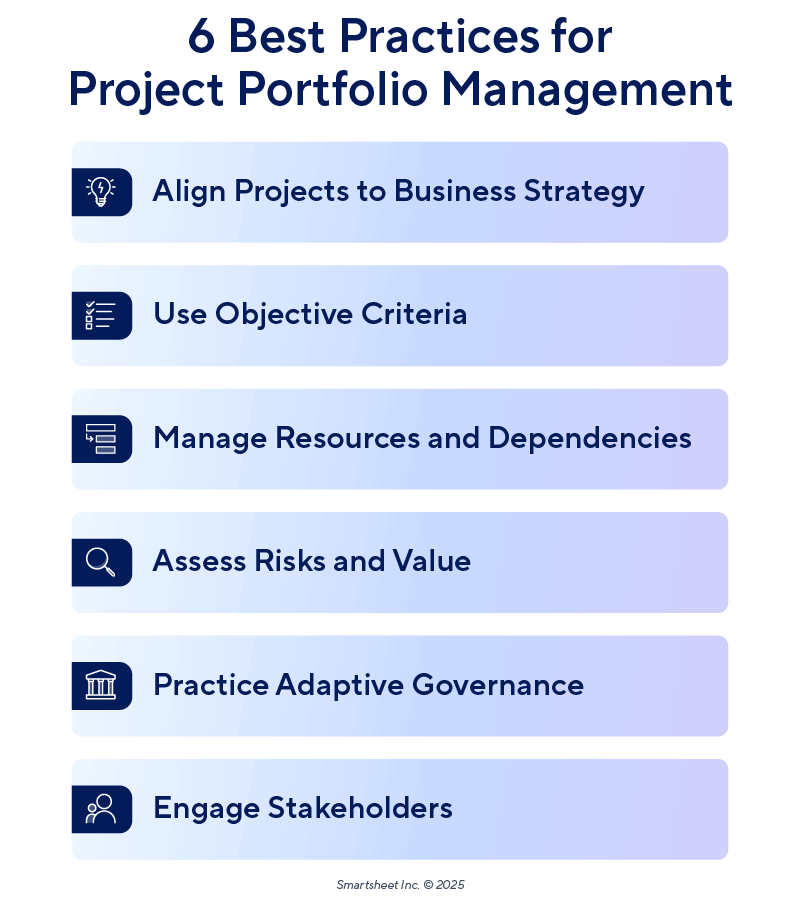
The top six project portfolio management best practices are aligning projects with business strategy, using objective criteria, managing resources and dependencies, assessing portfolio risks, conducting regular portfolio reviews, and involving stakeholders in decision-making. These practices help organizations choose the right projects, balance priorities, and make smarter decisions.
Below, you’ll find more detail about these top six PPM best practices:
Strategic alignment also helps prevent organizations from committing resources to projects that don’t deliver enough value.
“Every project should serve business goals. Every project in the portfolio should directly connect to shared business objectives. Otherwise, it drains resources without adding real value.”
— Avadh Nagaralawala, Automation and Control System Consultant at Caterpillar, Inc.
For example, if a company wants to increase its market share, it may decide to introduce a new product rather than improve its internal software, since a product launch more directly supports its growth strategy. As priorities change, portfolio leaders should review these decisions and shift resources to the projects that provide the best strategic value.
2. Use Objective Criteria
Prioritize projects using clear, organization-wide criteria, rather than relying on departmental preferences.
“A key mistake I see in PPM is that projects are often selected by individual departments based on local benefit, not overall organizational strategy. This pits groups against one another instead of sharing strengths, which keeps the organization from achieving its full vision.”
This practice is not just about having criteria, but about making sure you’re selecting the right criteria. “It’s common that the only metrics used to track and measure projects are ‘on time and on budget,’ instead of the actual business value and strategic outcomes achieved,” says Schuberth. “We must continue to assess impact during and after a project is delivered to best understand ongoing needs and investment priorities.”
When portfolio leaders apply clear, objective criteria, they can focus on the initiatives that deliver the most value. “Companies need to establish clear selection frameworks, specifically focusing on value creation, not politics or noise,” says Nagaralawala. Applying the same criteria throughout the portfolio also makes it easier to compare projects and explain funding choices.
3. Manage Resources and Dependencies
Every portfolio is more than a collection of separate projects. Because projects in a portfolio are connected, leaders should monitor how they depend on each other and manage shared resources. Regularly assess resource demand against capacity across projects to prevent overloading team members and to sequence work realistically.
Nagaralawala stresses the importance of this practice. “Portfolios fail not because projects are bad,” he says, “but because organizations overstretch people, budgets, or technology without proper sequencing.” With this level of visibility, portfolio managers can adjust schedules, resolve conflicts, and reallocate resources as needed. Doing so helps prevent one project from causing delays or capacity issues for others.
4. Assess Risks and Value
Beyond resources and dependencies, portfolio managers must monitor risk. They should balance projects to maximize value while considering risks and constraints, and adjust the portfolio as conditions change. Regular portfolio reviews help leaders identify when a project’s risk or value has changed.
“My company uses extensive real-time data and performance dashboards to make sure our portfolio decisions are captured in short-term deliverables as well as long-term growth.”
With this visibility, portfolio managers can adjust funding, schedules, or priorities as needed while balancing short-term performance with long-term goals.
5. Practice Adaptive Governance
Standardize who can approve decisions. By doing so, prioritization and resource allocation remain consistent and transparent throughout the organization.
Governance should support agility rather than rigidity. “There is a need for regular reviews and flexibility, especially for those industries that change quickly, like cybersecurity and data infrastructure, since priorities can shift fast based on new threats or market needs,” says Kalvo.
Regular reviews also allow leadership to make tough but necessary calls about how to allocate resources. “Organizations are often hesitant to stop investing in failing projects or projects that have delivered adequate value over including final shiny touches,” says Schuberth. “This wastes resources instead of leveraging them to bring more value to your organization or your customers through new initiatives.”
Nagaralawala suggests building in kill criteria: conditions that signal when to stop or re-evaluate a project before further investment.
6. Engage Stakeholders
Ensure that management transparently communicates project goals, status updates, and decisions across all levels of the organization. By engaging stakeholders early, you build trust and encourage faster, smarter decision-making.
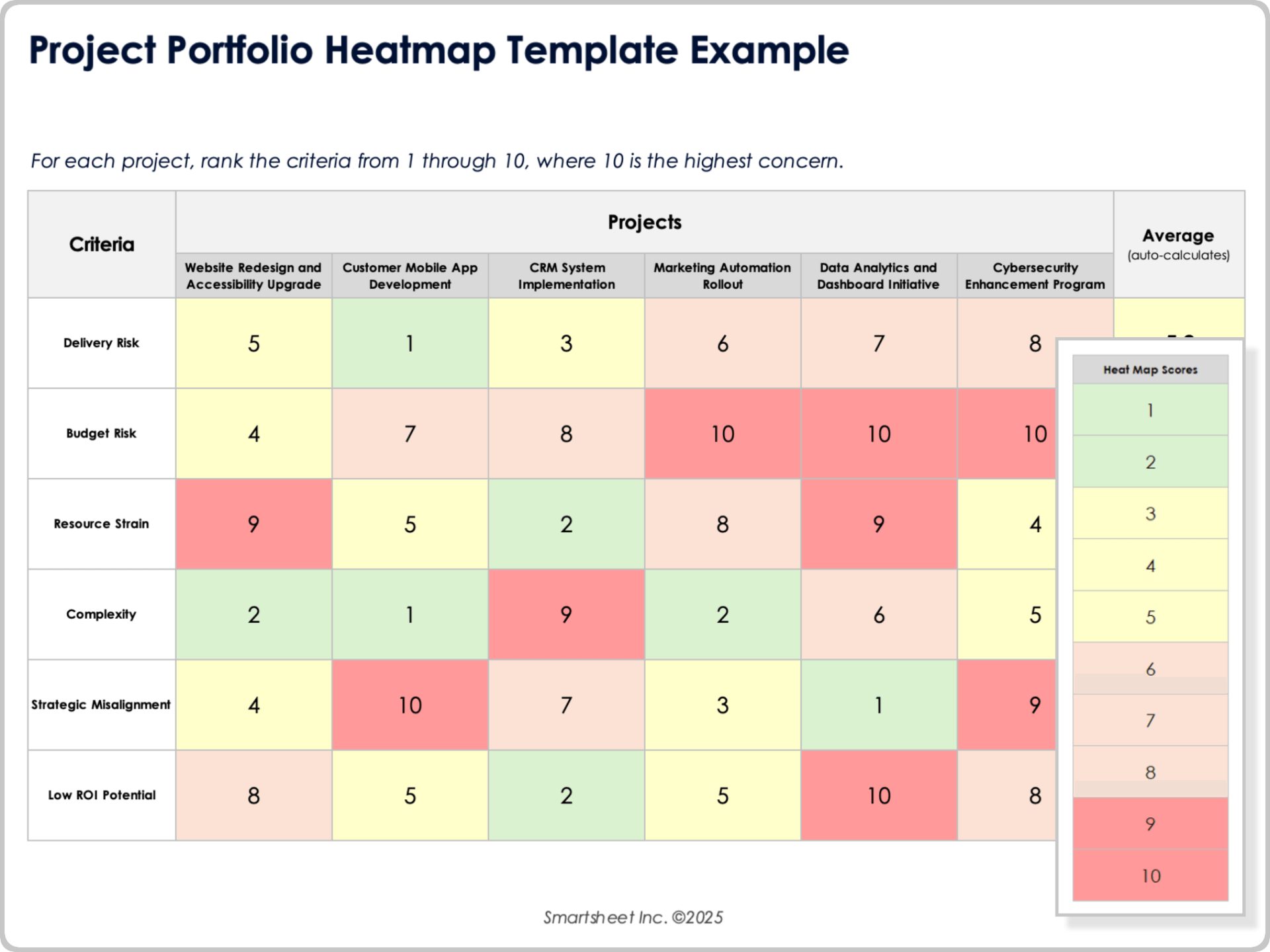
Teams can use this template to quickly compare multiple projects across key risk and value criteria. It’s designed for portfolio managers, project management offices (PMOs), or leadership teams to spot which initiatives need attention or carry the greatest risk. Simply enter details about each project and a score for the listed criteria, and the color-coded cells will display project health at a glance.
Project Portfolio Management Case Study
Below is a real-world project portfolio case study shared by Schuberth. In this situation, two PMOs merged without any resource visibility or strategic alignment. The table below explains how Schuberth’s team implemented a prioritization framework. Any team can use this approach to standardize project selection and resource allocation.
“It reflects the challenges and solutions common to a scaling organization navigating significant change, a key area for Cheryl Worldwide,” says Schuberth.
Challenge
Situation
Solution & Impact
Post-Acquisition Chaos
Two PMOs merged, resulting in more than 150 legacy projects, poor resource visibility, and zero alignment on strategic value. Teams were burned out and stuck.
Schuberth’s team introduced a single, transparent prioritization framework (with weighted scoring of strategic fit, risk, and ROI) to evaluate every project.
Resource Bottlenecks
Critical subject matter experts (SMEs) were unknowingly allocated to 150 percent of their capacity across projects in both organizations.
Her team established a centralized resource capacity model on the platform. The PPM team held transformative conversations with executive leadership to force a stop/defer/go decision on the bottom 40 percent of the portfolio.
No "Kill Switch"
Projects that were failing or no longer strategically relevant kept consuming budget due to political inertia.
Schuberth implemented a quarterly portfolio review rhythm to objectively measure projects against their strategic outcome. If a project missed its key result, the default decision was to terminate it unless the sponsor presented a compelling, pre-approved case to adjust the strategic outcome and secure new resources.
“Within six months, the organization reduced its active project count by 35 percent, completing the strategic integration initiatives three months ahead of schedule by reallocating $1.2 million in capital freed from the canceled projects,” says Schuberth. “The PPM practice became the engine for operationalizing the vision for the newly merged entity.”
Make a business case for Project Portfolio Management
Best Practices for AI-Driven Project Portfolio Management
Best practices for AI-driven project portfolio management include aligning AI tools with business strategy, ensuring data quality, and integrating predictive analytics for more accurate forecasting. Start with pilot projects, invest in change management to drive adoption, and balance AI insights with human judgment.
PPM works best when managers choose projects not just for their individual benefits, but for how well they support organizational strategy. AI can process large quantities of data to spot patterns and predict which projects will create extra value when combined — something humans might miss.
However, in a 2024 study on the use of AI by project, program, and portfolio managers, “Artificial Intelligence and Project Management: Empirical Overview, State of the Art, and Guidelines for Future Research,” researchers advise caution while adopting AI methods. While they found portfolio management use cases in automated forecasting, risk assessment, resource allocation, and data-driven decision support, they also found significant drawbacks, such as poor data quality, lack of transparency in AI decision-making, and limited strategic impact.
Nagaralawala and Schuberth both echo this sentiment. “AI struggles with context, politics, and cultural nuances — areas where leadership and human experience are irreplaceable,” says Nagaralawala. “For example, deciding to continue or cancel a project often depends on stakeholder trust and strategic timing, not just numbers.”
Similarly, Schuberth explains that at Cheryl Worldwide, AI is viewed as an “execution accelerator,” but is not used for tasks that “require human intervention, judgment, and emotional intelligence.”
Top 4 Best Practices for Using AI in PPM
Start With the Data Foundation: AI is only as good as the data it analyzes. Standardize data fields (risk ratings, status codes, resource roles) across PM and PPM systems before implementation.
Define the "Why": Use AI to solve a specific business problem (e.g., "We are consistently late in resource assignment," or "Our data is untrustworthy"), not just to have the latest tech.
Embed Human Oversight: Treat AI recommendations as decision support, not decision replacement. Every high-stakes AI output (e.g., a portfolio rebalancing suggestion) must be reviewed, vetted, and signed off by a human portfolio manager.
Prioritize Transparency: Leaders must be able to explain how the AI arrived at its recommendation to build trust across the organization. People need to understand the "why" of the algorithm.
Ultimately, when used with human oversight, AI is a powerful tool in portfolio management. For example, Smartsheet AI offers a suite of features designed to blend automation, analytics, and intelligent assistance. It provides data-analysis and formula generation capabilities, as well as AI agents and workflow automation. These tools not only help plan projects and flag risks, but can step in to carry out tasks — with employee approval — and automate multistep processes at scale.
AI Features for PPM Software Comparison Chart
To make the most of AI in intelligent project portfolio management, teams should understand not only what tools are available, but also how to apply them responsibly. The table below highlights key AI features, along with practical guidance for using each effectively.
AI Feature
What It Does
Best Practice for Use
Predictive Forecasting
Analyze project performance and resource data to predict delays or overruns.
Use as an early-warning system. Always validate forecasts with team input.
Risk Identification and Scoring
Flag potential schedule, budget, or dependency risks based on patterns in historical data.
Regularly update data sources to maintain accuracy; combine with human risk reviews.
Resource Optimization
Suggest how to allocate or reassign resources across projects for best portfolio efficiency.
Review AI recommendations in the context of team capacity and skills before approving.
Automated Reporting and Dashboards
Compile and summarize project data for leadership visibility.
Customize dashboards to focus on only a few, decision-relevant KPIs; avoid overloading with metrics.
Workflow Automation
Execute routine project tasks, reminders, or approvals.
Start small by automating repeatable tasks first; ensure human review for exceptions.
Manage Your Project Portfolio Better With Smartsheet for Modern Project and Portfolio Management
Connect the dots between strategy and execution to deliver value at scale.
Amplify the value of your project portfolios with a platform that combines flexibility, process standardization, and enterprise-class governance. With Smartsheet, you can build projects, automate work, and accelerate time-to-market.
Learn how Smartsheet empowers teams to plan, implement, and scale projects, programs, and portfolios and deliver results faster. Watch the Projects and Portfolios demo.
PPM Best Practices FAQs
Common PPM mistakes include ranking projects without clear criteria, accepting more work than available resources can handle, neglecting project dependencies, and not revising priorities when circumstances change. These errors can cause delays, resource conflicts, and continued investment in low-value work.
Project portfolio management (PPM) is the process of selecting, prioritizing, and managing projects as a portfolio, while a project management office (PMO) is an organizational function that can set standards, support project teams, maintain governance, and may help manage projects or portfolios.
AI is used in project management to summarize project data, identify risks and trends, support prioritization, forecast resource needs, and automate standard reports. It can also help leaders review larger amounts of portfolio information more quickly while keeping people accountable for key decisions.
Learn how teams apply AI to planning, scheduling, reporting, risk management, and other aspects of project work in our guide on AI in project management.
Dive into the top PPM FAQs, resource management challenges, and how to measure portfolio ROI. Plus, a detailed look at Smartsheet for enterprise portfolio.