

A program management office (PgMO) helps organizations coordinate related projects, support program managers, and align program work with business priorities. We’ve compiled the benefits and best practices of a program management office, steps to take and avoid when setting one up, expert advice for running one, and more.
Key Takeaways
- A program management office should prioritize establishing trust. It is less effective if employees view it as bureaucratic, if departments view it as a competitor for resources, or if managers doubt how it sets priorities. To win trust, the PgMO must demonstrate value, remain neutral, and help teams get their work done.
- A PgMO should go beyond judging whether projects finish on schedule and within budget; measures such as strategic spend, time-to-market, return on investment, benefits realization, and quality can show whether program work delivers business results rather than merely showing that teams comply with established processes.
- A PgMO must evolve as the organization changes, keeping up with staff experience, staff turnover, shifts in business priorities, and other structural changes that indicate that it may need to adjust its services. The office should not assume that the model that worked when the initiative launched will not keep working indefinitely.
What Is a Program Management Office?
A program management office (PgMO) is an entity within an organization that provides teams with training, support, tools, and expertise for project and program management. It establishes standard procedures, coordinates related activities, and ensures program activities align with the organization’s goals and priorities.
Learn more about the essentials of program management and how it differs from project management.
What Does a Program Management Office Do?
The program management office oversees the projects that make up a larger program and establishes the roles, processes, methods, and tools needed to manage them. It coordinates information and resources shared across projects, monitors project performance and benefits, and tracks risks and issues that the program manager can then resolve.
Check out our guide to project organizational structure to select the best structure for your organization, and try one of our Gantt chart templates for multiple projects.
When Is It Time to Make a Change in the Program Management Office?
You may need to change your program management office if its structure, processes, or priorities no longer fit your organization’s needs. Your organization’s business goals may have shifted, or your staff skills may be outgrowing the PgMO’s processes. If they find it stagnant or overly bureaucratic, you may experience high turnover.
Here are some common signs that your program management office may need to change:
- Shifting Business Drivers: If your organization’s goals, strategy, or needs change, the PgMO needs to update its priorities or processes. If you have weak strategic alignment, even an effective PgMO cannot stay relevant.
- Delivery Gaps: If programs consistently under-deliver, make inaccurate forecasts, or experience ineffective governance, the PgMO likely needs an overhaul.
- Maturing Staff: If teams are using new tools, skills, or delivery methods that have outgrown the PgMO, the PgMO will need to change or integrate to catch up.
- Resource Conflicts: Recurring resource competition, over-allocation, or skill shortages may indicate that the PgMO needs a clearer process for prioritizing and allocating work.
A program management office should also follow continuous improvement principles. Learn more about case studies, methodologies, benefits, and more in this guide to continuous improvement.
You can also track the need for change through baseline surveys and balanced scorecards. These tools can help show how employees and stakeholders view the PgMO and where the office may need to improve. Learn more in this complete guide to balanced scorecards.
Project Management Office vs. Program Management Office
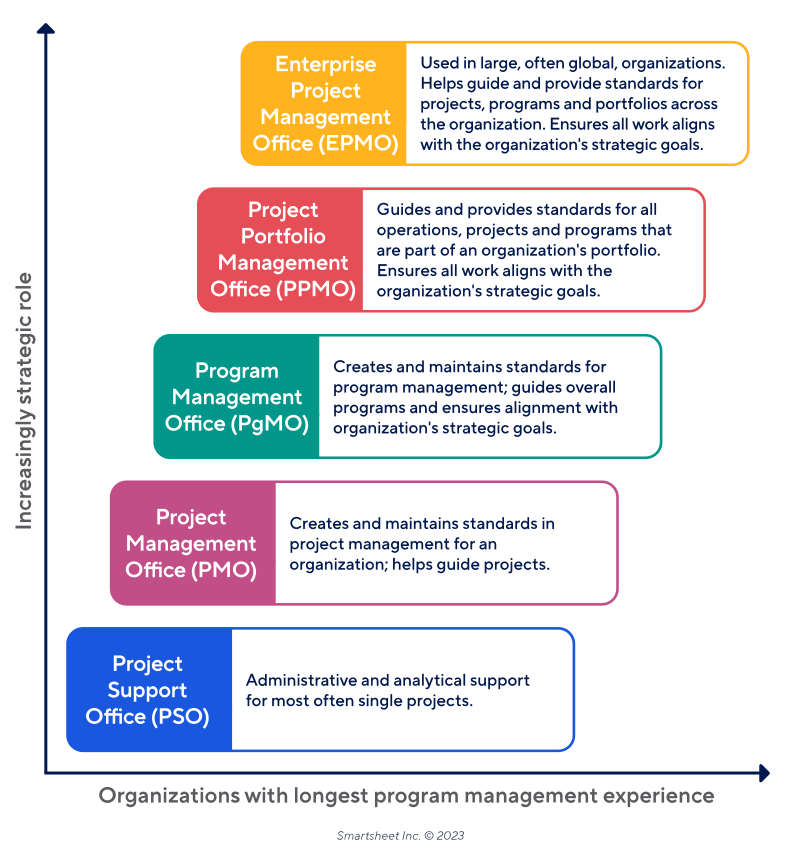
A project management office (PMO) guides projects for an organization. A program management office focuses on an organization’s overall programs as well as the strategic goals of an organization.
In some ways, the two offices are similar. They both support organizational change and can establish methods, processes, and templates for project and program work. They also support governance, provide training, track risks, and help leaders make informed decisions.
But while a project management office focuses on the organization’s projects, a program management office focuses on broader areas for the organization. It works to help guide larger programs that are often made up of related projects. And it works to ensure those broader programs are aligned with the organization’s overall strategic goals.
Below is a graphic that provides details on some of those offices and their characteristics and mission.
Learn more about project integration management and project portfolio management.
Types of Program Management Offices
Program management offices vary in the amount of authority and control they have over program work. Some support a single complex program, while others provide ongoing support for programs across the organization. A PgMO might directly manage program work, enforce practices, or simply advise teams.
The Project Management Institute categorizes project management offices as supportive, controlling, and directive, “based on the influence and degree of control they have on projects within the organization.” Program management offices are not formally categorized this way, but they can be described using a similar framework based on how much authority a PgMO has over program work — a PgMO may be supportive, controlling, or directive depending on whether it primarily advises program leaders, draws up rules for program work, or more directly manages and coordinates programs.
- Supportive: A supportive PMO provides resources like training, project data, and lessons learned, while project managers retain decision-making authority. A supportive PgMO, similarly, would assist the program manager and teams with planning, coordination, and reporting on program-level work.
- Controlling: A controlling PMO provides support but also defines methods, reporting formats, tools, or governance processes that projects have to follow. A controlling PgMO similarly establishes required program-management practices and monitors compliance, while the program manager remains responsible for day-to-day delivery.
- Directive: A directive PMO directly manages projects and has the highest degree of control. A directive PgMO would likely also have a hands-on role in directing program work, such as overseeing program-management staff, coordinating component projects, and managing key dependencies.
How to Set Up a Program Management Office
A program management office should start with a clearly defined purpose. Before setting up a PgMO, an organization should decide what problems the office will solve, what programs it will support, and which executive sponsor will help establish authority and organizational support.
Here are six important steps to setting up a PgMO:
1. Define the Problem
You must define why your organization needs a program management office. Document your current problems, processes, tools, capabilities, workload, and stakeholder needs. “It really comes from identifying what the challenge or opportunity is, then addressing it by saying, ‘We need to put some meat behind it,’” says Randy Englund, a project management consultant and co-author of The Complete Project Manager: Integrating People, Organizational, and Technical Skills.

“[Setting up] a program management office is the way to walk the talk,” Englund says. “You’re sending the message that you’re serious.”
2. Find an Executive Sponsor
Setting up a PgMO costs money and takes time. Without enthusiastic support from a top leader, it won’t succeed. It may not even survive the long process of getting started.
“Find an executive sponsor who understands and supports PgMO actions,” Englund says. “This is a critical prerequisite.”
3. Define Scope
Create a charter for the program management office to lay out why it exists, what it will do, and how it will do it. This document should specify governance details, including who makes what decisions and how they are escalated, as well as what does and does not fall under the purview of the PgMO.
The charter “serves as operating instructions to authorize, staff, and support the program,” Englund says. It should also “identify [a] specific problem it solves,” like “improving time to market, facilitating portfolio management, or leading the continuous improvement of project management across the organization.”
You may also want a broader vision statement about what the program management office could accomplish.
“A program vision statement is a vivid description of a future state when program objectives are achieved,” Englund says. “It needs to be clear, concise, convincing, and compelling. It does not describe how the work is done — it just describes what can be seen, heard, or felt when accomplished. When done well and written in the present tense, the vision statement motivates people by the energy it creates in wanting to make it happen.”

Jake Carroll, founder of Create Kaizen, a consulting company focused on personal, team, and organization development, says that “defining what the PgMO does, and especially defining what it doesn’t do — are very, very important.”
Review and download free program charter and other program management templates in our collection. Also check out our selection of free vision and mission statement templates.
4. Establish Structure and Processes
Establish in detail how your organization will structure and govern the office, including how positions within the office will be aligned and who will report to whom. Establish core workflows, templates, data standards, reporting cadence, systems, and a source of truth for program information.
5. Determine Metrics
Before launch, define the metrics and KPIs you will use to assess whether the PgMO is improving outcomes. This is not about producing reports or enforcing new processes, but about benefits-realization: involving stakeholders early to identify, track, and improve on expected outcomes. These could include cost performance, resource capacity, risk management, stakeholder experience, and more.
6. Launch PgMO
Use a roadmap to launch the PgMO in phases. Identify initial services, pilot areas, and milestones, and lay out what resources are needed for which phase. Lay out a clear path from current to future state.
Use change management techniques to ensure that affected teams are provided with the necessary training and feedback channels to effectively adopt the new office processes. Identify leaders and other stakeholders who are aligned with the office and can motivate teams about the office’s potential.
7. Monitor and Improve
The PgMO should regularly review whether staff are using its services and how its services are helping deliver results, including helping leaders make decisions and keeping programs on track. If needed, it should update its responsibilities, processes, staffing, and support as the organization’s goals and program needs change.
Program Management Office Structure
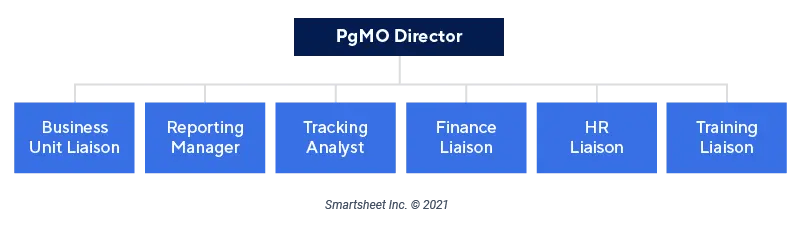
A program management office will most often have a director to lead the office, and program managers who work under them. It might also include a tracking analyst and liaisons to business units, finance, and other areas.
Below is an example of a possible organizational structure within a program management office.
- PgMO Director: Creates and guides plans for organization programs; oversees adjustments to programs; supervises program managers.
- Program Managers: Work with other team members to help plan capacity and guide projects or programs.
Program Management Office Roles and Responsibilities
In many organizations, a program management office might be relatively small. It often is made of a director and managers that work with specific projects or programs.
Team members might include the following roles:
- Program Management Office Director: Creates and guides plans for organization programs; oversees adjustments to programs; supervises program managers.
- Program Managers: Work with other team members to help plan capacity and guide projects or programs.
Program Management Office Best Practices
Experts recommend several best practices to set up and run program management offices. Best practices include recruiting the right people to staff your office, communicating well, and continuing to evolve.
Here are some important best practices that PgMOs should follow:
- Align Programs to Strategy: Each program should have a clear connection to organizational priorities and measurable success criteria. As the organization’s strategy and program costs and risks change, the program should be continuously reviewed for relevance.
- Recruit Expertise: A PgMO should be staffed with passionate and experienced people who understand and believe in the office’s mission. They should have program-management experience and be able to work effectively across departments. They should understand stakeholder engagement and governance, be familiar with the organization’s delivery methods, and be able to adapt as program and business needs change.
- Establish Clear Governance and Reporting: Define who recommends, approves and makes decisions about program priorities. The PgMO should have an executive sponsor with enough authority to support its work, and direct access to the leaders who make decisions about program priorities. “Have the office report high up in the organizational structure so they are not biased toward any one functional area,” Englund says. Visibility is also important. Make sure top leaders are aware of what the office is doing and achieving, so they understand how the office’s work aligns directly with business strategy success.
- Keep Things Simple: Avoid unnecessary bureaucracy and ensure the minimum level of process that is still effective. More complex programs may require more formal governance, but in general, employees should trust that the PgMO is necessary to get things done.
“Gain a reputation as necessary and productive,” Englund says. “It needs to not be perceived as bureaucratic overhead — ‘Oh, here comes that pesky program manager. He just needs to get his document completed. And he’s bugging me again.’” - Be Transparent: Clearly communicate the office’s goals, activities, future plans, and successes, including sharing best practices to help you win support from top leaders as well as employees. This also includes accepting feedback from stakeholders who may be resistant to the office’s goals, and making adjustments as needed.
- Prioritize: Organizations must prioritize projects that help them reach organizational goals. Program management offices must do the same. “The fluidity of the office means that a lot of different people from all around the company come to us for a lot of different things,” Carroll says. “And if we don’t have a standard way of prioritizing not only what we support, but how much time we spend supporting it, then we’re doomed to fall into that administrative role. That further lessens our value for the company. And further lessens our validation to increase the scope of things we work on. It’s very easy to get pigeonholed in that role.”
- Continually Assess and Improve: Your program management office will likely teach employees how to continually evolve and improve processes and products as they work on projects and programs. You should treat your own office as a product. That means its processes should also always evolve and improve.
“Don’t be tied to certain things because that’s the way you’ve always done them,” Carroll says. “You should continually be in a state of discovery. You should continually be in a state of iteration.”
Here are some top key performance indicators (KPIs) for program management offices:
KPI | Description |
Time-to-market | Average time for a product to get to market, for organizations that have programs overseeing product development |
Quality control | % of products that meet defined quality criteria |
Cost performance | % of projects in a program within budget limits |
Strategically aligned investment | % of program investment tied to strategic objectives |
Portfolio-level return on investment (ROI) | Total realized net benefits from all programs divided by total investment |
Benefits of a Program Management Office
A well-managed program management office can offer many advantages to an organization. It can increase efficiency, improve coordination between projects and programs, and help teams achieve better results. It can also standardize processes, align projects and programs with broader organizational goals, and help leaders make better decisions about resource use.
Here are some common benefits that a program management office can provide:
- Alignment With Organizational Goals: A good program management office will ensure that all integrated teams monitor all projects and programs and that all projects and programs have a direct link to a company’s strategic goals.
- Stakeholder Engagement: A program management office can make the case for certain projects, coordinate communication across departments, and address resistance and support adoption among employees.
- Standardization: Like PMOs, PgMOs can provide standardized tools and processes to organize and work on projects so that employees can use their time more efficiently. According to the 2025 PPM Priorities Report from Smartsheet, 58% of PPM professionals say their current tools are insufficient, and 99% say their organization would benefit from better technology that helps them adapt to change.
- Coordination: A program management office can coordinate related projects, dependencies, and shared resources to achieve a degree of collaboration that is not possible when projects are managed separately. It can also help with handoffs and sequencing to keep related work moving together.
- Better Program Decisions: A program management office can give leaders a broader view of programs, priorities, and performance. With this level of visibility, they can make better decisions about where to allocate resources, manage conflicting priorities, and keep program work aligned with the organization’s strategy.
- Improved Benefits Realization: A PgMO can help define, measure, and track the benefits a program is supposed to deliver. It can also assign owners for those deliverables to hold the right people accountable.
- Clearer Governance and Allocation: A PgMO establishes governance processes that clarify who makes key decisions and how issues should be escalated. It also creates more visibility into shared resources so leaders can ensure that they are not over- or under-allocating.
Below is a grid that provides details on some of the responsibilities of a program management office. Several of those responsibilities are more narrow; others are more strategic and focus more broadly.
Program Management Office: Two Levels of Work
More Direct and Narrow Work: Project Level Help | Bigger Picture Work: Strategic Thinking and Guidance |
|---|---|
Trains and mentors staff, helps them develop skills in project and program management | Ensures all projects and programs align with organization's strategic goals |
Ensures teams follow defined project management processes, produce required reports | Establishes a structure and decision-making criteria that allows organization to set priorities for all projects and programs. |
Helps direct regular communications to wider teams about specific project and program work | Ensures that employees can execute similar projects in a consistent way and that the project processes are repeatable. |
Provides tools and resources that help employees understand and use best practices in project management | Encourages continuous improvement processes in organization's projects and programs, and in the program management office. |
Directly runs some projects and programs | Establishes appropriate KPIs that then monitor the effectiveness of all projects and programs |
Helps to manage collaboration and information-sharing among projects related to each other or part of one program | Communicates to upper management about structural hurdles that affect projects and programs |
Pitfalls to Avoid When Setting Up a Program Management Office
When setting up a program management office, it’s important to recognize it as an ongoing adoption effort — it is a mistake to think that once a plan is delivered, everyone will adhere to it. Experts caution against treating it as a planning exercise, launching without clear scope or decision rights, and ignoring silos and dependencies. Organizational obstacles, internal politics, funding disagreements, and competing priorities can also hinder success.
Bad project execution can be expensive. According to the PMI Pulse of the Profession 2026 report, found that 31% of complex projects do not achieve the full scope of intended benefits. The Wellingtone State of Project Management 2026 report found that only 36% of organizations consistently finish their projects on time.
Here are some common pitfalls to avoid:
- Delivering a Transformation Plan and Schedule and Thinking You’re Done: Your office will need to do more than simply lay out a new plan and way of doing things and then just monitor progress. This will be an ongoing adoption effort and teams have to adapt to the changes your office will likely be recommending. Change management is essential in supporting this continuous transition.
- Ignoring the Silos: Organizational silos can be common. Programs often involve several departments or initiatives that may not be coordinating with each other. Organizations can even unintentionally reward that by using key performance indicators focused on the work of individual departments.
But programs almost always involve work and goals that encompass the entire enterprise’s portfolio. Leaders in the program management office should help leaders align objectives and establish clear communication across departments. - Allowing Unclear Funding Decisions: Employees and department leaders should not see the new program management office as competing for organizational funding that otherwise would go to a specific department. “Be careful not to usurp resource allocation away from function managers — which then creates resistance,” Englund says.
- Prioritizing Projects Based on Sponsor Influence: The program management office can’t be seen as favoring work and ideas from a specific company leader or group of leaders. The program management office should use a collaborative and transparent process to prioritize strategic alignment.
The Evolution and Future of the Program Management Office
Program management offices grew out of project management offices. In 1911, Frederick Taylor published his monograph The Principles of Scientific Management, laying out how to maximize efficiency in the workplace and therefore ensure success for an organization. By the 1930s, the U.S. Army Air Corps had created project offices to help them manage the development and delivery of their aircrafts.
The Project Management Institute was formed in 1969 to strengthen our understanding of project and portfolio management and help build skills to strengthen large organizations. Project management grew in 1998 with the creation of the federal Y2K office, a special office to coordinate federal, state, local, and international efforts to fix the computer software used to note dates.
In 2006, PMI published its first Standard for Program Management, helping establish program management as a separate discipline focused on coordinating multiple projects to achieve wider objectives. Today’s program management offices handle more complex projects and faster technological change. According to PMI, 81% of project professionals believe projects have become more complex in recent years, and 50% of CEOs name AI and automation as a major cause of changes to their operating models.
As pressures grow, program management offices will play a greater role in coordinating dependencies, setting priorities, steering decisions, and helping teams acclimate to new ways of working. Although AI and automation might change how teams plan, report, and monitor their work, the program offices will still need people who can use judgment, manage tradeoffs, and keep programs focused on delivering results.
Improve how your organization prioritizes projects, allocates resources, and manages work across a portfolio with our complete guide to project portfolio management.
Power Your Program Management Office with Smartsheet
From simple task management and project planning to complex resource and portfolio management, Smartsheet helps you improve collaboration and increase work velocity -- empowering you to get more done.
The Smartsheet platform makes it easy to plan, capture, manage, and report on work from anywhere, helping your team be more effective and get more done. Report on key metrics and get real-time visibility into work as it happens with roll-up reports, dashboards, and automated workflows built to keep your team connected and informed.
When teams have clarity into the work getting done, there’s no telling how much more they can accomplish in the same amount of time. See how Smartsheet streamlines project intake, improves visibility across programs, and supports better resource decisions. Watch the Projects and Portfolios demo.
FAQs about Program Management Office
A program management office oversees programs, coordinates projects, and supports delivery across the organization, while a center of excellence builds capability by establishing standards, methods, tools, training, and best practices. Some organizations combine the two functions, while others keep them separate.
The time it takes to set up a program management office depends on the project’s scope, available authority, staffing arrangements, and the organization’s readiness to change. Generally, the process includes stating the office’s purpose, assessing existing capabilities, securing senior leadership support, establishing the necessary processes, and staffing the team before wider implementation starts. Setup may take many months, with more complex implementations taking longer.
